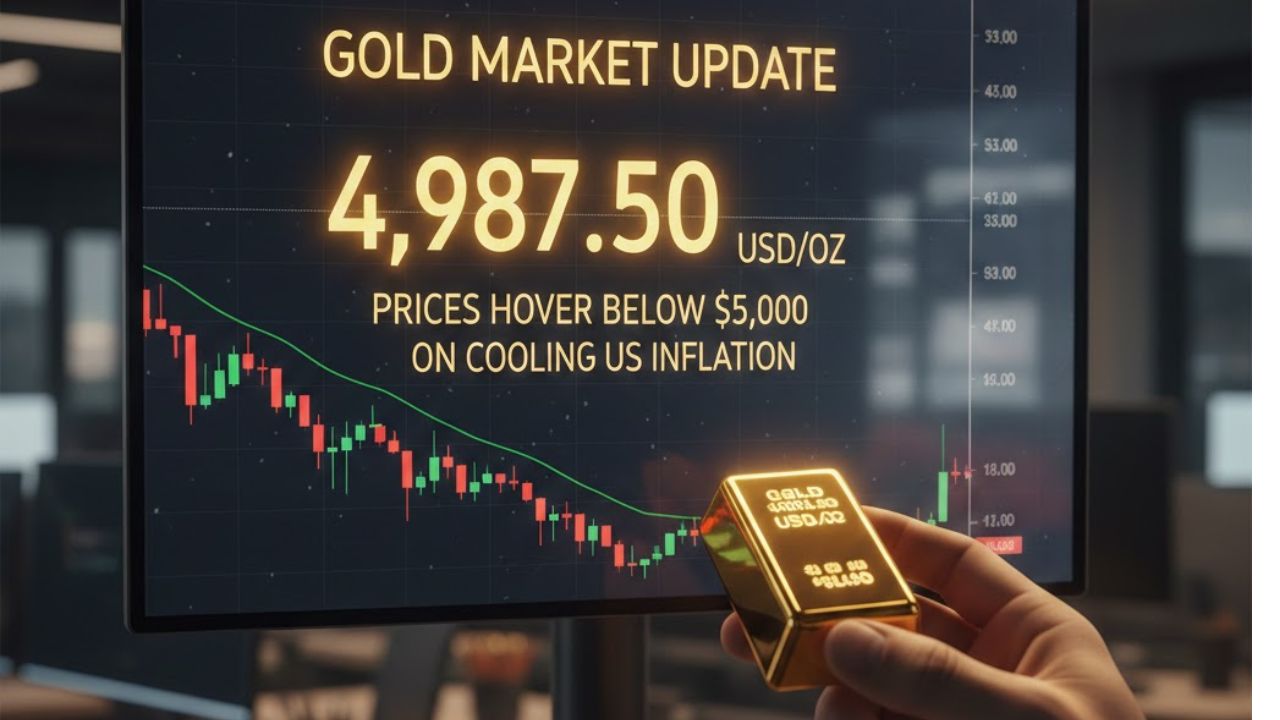
The global precious metals market has entered a phase of intense scrutiny and strategic recalibration as gold prices continue to hover just beneath the psychological threshold of $5,000 per ounce. Following a period of historic highs, the yellow metal experienced a notable pullback, driven by shifting macroeconomic indicators and a cooling trend in United States inflation. For investors, this movement represents more than just a price correction; it is a response to the Federal Reserve’s evolving stance on monetary policy. As inflationary pressures show signs of stabilization, the urgency for aggressive interest rate hikes has diminished, creating a complex environment for “safe-haven” assets that typically thrive on economic volatility.
The Impact of Cooling US Inflation
The primary catalyst for the recent price action in the gold market is the release of softer-than-expected inflation data from the US Bureau of Labor Statistics. In early 2026, the Consumer Price Index (CPI) indicated a cooling trend, with figures coming in at 2.4% year-over-year. This cooling effect has provided the Federal Reserve with the necessary breathing room to consider a more dovish approach to interest rates. Historically, gold maintains an inverse relationship with interest rates and the US dollar; when inflation cools and the prospect of rate cuts emerges, the opportunity cost of holding non-yielding assets like gold decreases. However, the current market is characterized by “position-adjustment,” where traders are balancing their portfolios after a massive rally that saw gold peak near $5,600 in late January.
Market Statistics and Comparative Performance
To understand the current standing of precious metals, it is essential to look at the recent price corrections across various purity levels and global markets. The following table illustrates the price dynamics as of mid-February 2026.
| Gold Purity / Metal | Current Price (Spot/Avg) | Weekly Change | Support Level |
| Gold 24K (per 10g) | ₹155,770 / $4,980 (oz) | -1.8% | $4,900 |
| Gold 22K (per 10g) | ₹142,790 | -1.9% | ₹140,000 |
| Silver (per kg) | ₹2,79,900 | -2.4% | ₹2,70,000 |
| Platinum (per oz) | $2,066 | -4.1% | $1,950 |
Investor Sentiment and Profit Taking
As gold reclaims and subsequently tests the $5,000 mark, institutional and retail investors are engaging in significant profit-taking. After gold’s relentless run throughout 2025—which delivered triple-digit returns in some domestic markets—the current dip is viewed by many as a healthy correction. Analysts suggest that the rapid appreciation in late 2025 and early 2026 left the market overbought. Consequently, when the US dollar showed signs of stability amid the cooling inflation reports, many “conviction buyers” opted to liquidate portions of their holdings to lock in gains. This “de-risking” behavior has created a temporary ceiling for gold, keeping it in a tight trading range as the market searches for the next major catalyst.
The Role of Central Banks and Global Demand
Despite the short-term fluctuations, the underlying structural demand for gold remains robust. Central banks, particularly in emerging markets, continue to diversify their reserves away from the US dollar. In 2026, central bank gold purchases are expected to remain elevated, albeit slightly below the record-breaking levels seen in the previous two years. This institutional support provides a formidable floor for prices, preventing a complete collapse even when inflation figures surprise to the downside. Furthermore, demand from major consuming nations like China and India remains a critical factor. With the Lunar New Year and wedding seasons influencing physical demand, any dip toward the $4,800 level is likely to be met with aggressive “buy-the-dip” activity from Asian markets.
Technical Outlook and Resistance Levels
From a technical perspective, gold is currently navigating a crucial support zone between $4,915 and $4,950. If the metal can maintain its footing above the 20-day Exponential Moving Average (EMA) of $4,971, the path toward reclaiming $5,100 remains open. However, a sustained break below $4,900 could trigger a deeper correction toward the 50-day EMA near $4,600. Market participants are closely watching the Federal Open Market Committee (FOMC) minutes and upcoming Gross Domestic Product (GDP) estimates to gauge the health of the US economy. A “soft landing” scenario—where inflation is tamed without a significant recession—could keep gold in a consolidation phase for the remainder of the quarter.
Future Projections for 2026
Looking ahead, major financial institutions maintain a generally bullish outlook for the end of 2026. While the immediate focus is on the $5,000 threshold, long-term forecasts from banks like Goldman Sachs and JP Morgan suggest that gold could target the $5,400 to $6,000 range by the fourth quarter. These projections are predicated on the assumption that real interest rates will eventually trend lower and that geopolitical tensions will continue to drive demand for defensive assets. For now, the “cooling inflation” narrative is the dominant force, keeping the gold market in a state of watchful waiting as it balances between previous records and future growth.
FAQs
Q1. Why did gold prices fall below $5,000 recently?
The dip was primarily caused by “profit-taking” from investors following a massive rally and a cooling US inflation report (2.4%), which slightly strengthened the US dollar and reduced the immediate urgency for gold as an inflation hedge.
Q2. Is now a good time to buy gold?
Many analysts view the current correction as a “buying opportunity” for long-term investors, as the fundamental drivers—such as central bank demand and geopolitical uncertainty—remain intact despite short-term price volatility.
Q3. How does inflation affect gold prices?
High inflation typically drives gold prices up as investors use it to preserve purchasing power. Conversely, when inflation “cools,” the pressure on the Federal Reserve to raise rates eases, often leading to a temporary stabilization or dip in gold prices.
Disclaimer
The content is intended for informational purposes only. you can check the officially sources our aim is to provide accurate information to all users