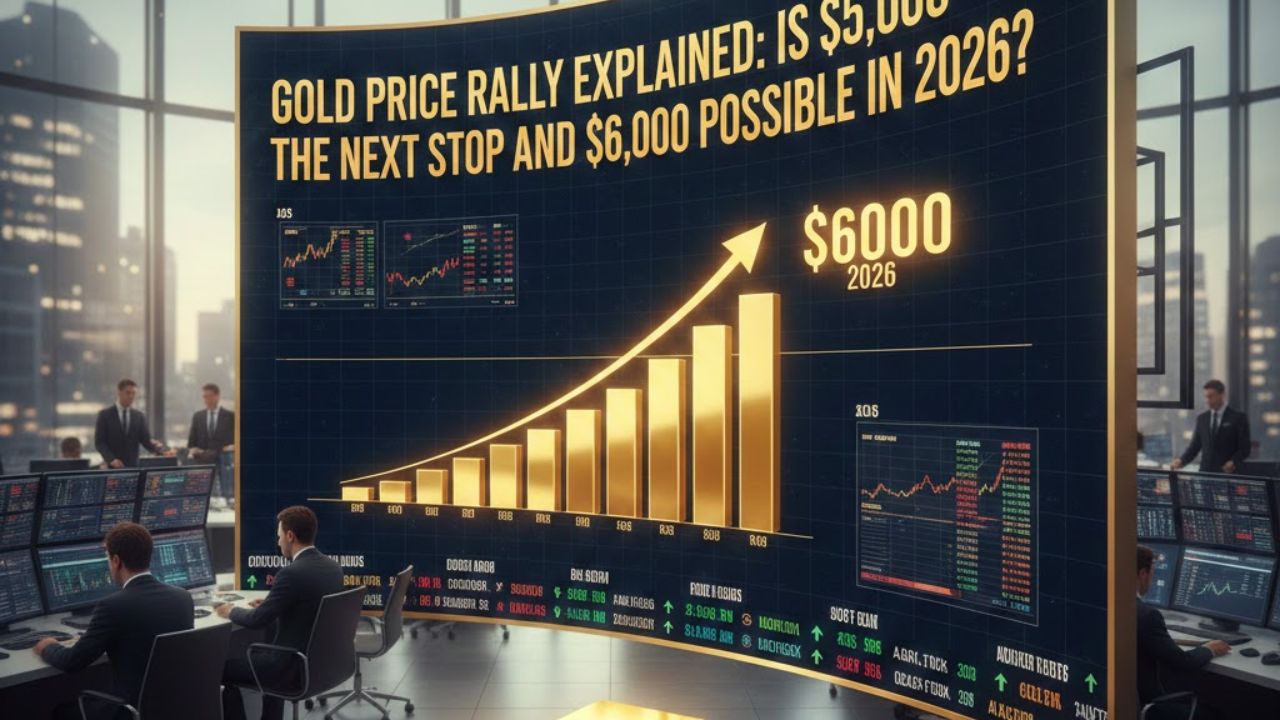
The global financial landscape is witnessing a historic transformation as gold prices shatter long-standing psychological barriers. After a relentless rally in 2025, the yellow metal has firmly established itself above the $5,000 mark in early 2026, prompting investors and analysts to reassess the upper limits of this bull market. What was once considered a “moonshot” prediction—gold at $6,000—is now being discussed by major financial institutions as a tangible reality within the next 12 to 18 months. This surge is not merely a speculative bubble but the result of a “perfect storm” of macroeconomic shifts, ranging from aggressive central bank diversification to persistent concerns over currency debasement.
The Psychological Breach of $5,000
Breaking the $5,000 per ounce threshold in early 2026 served as a watershed moment for the commodities market. For decades, gold was viewed through the lens of traditional inflation hedging, but the current movement suggests a deeper structural change. Technical analysts point to a “price discovery” phase where old resistance levels have become new floors. Despite periodic corrections—such as the sharp 3% to 4% dips seen in February 2026 due to strong U.S. labor data—the dip-buying appetite remains voracious. Large-scale investors are no longer asking if gold is overvalued; they are asking how much higher the ceiling can go as the $5,000 support level holds firm against market volatility.
Central Banks: The New Foundation of Demand
One of the most significant drivers behind the current rally is the systematic shift in how central banks manage their reserves. Emerging market economies, led by nations like China and India, have aggressively diversified away from the U.S. dollar, favoring the neutrality and safety of physical bullion. In 2025 alone, central bank gold demand exceeded historic averages, and this trend has accelerated into 2026. Gold now represents a growing percentage of total global financial assets, rising to nearly 3% as institutions seek to insulate themselves from geopolitical sanctions and the risks associated with fiat currency. This “institutional floor” provides a level of price stability that prevents the drastic crashes seen in previous cycles.
For gold to reach the $6,000 milestone by the end of 2026, several macroeconomic stars must align. Foremost among these is the trajectory of U.S. monetary policy. While the Federal Reserve has navigated a complex “higher for longer” interest rate environment, any pivot toward sustained rate cuts significantly lowers the opportunity cost of holding non-yielding assets like gold. Furthermore, the “de-dollarization” narrative has gained significant steam. As sovereign debt levels in advanced economies reach unprecedented heights, the perceived risk of currency debasement drives both retail and institutional capital into precious metals. If the U.S. dollar continues to face credibility challenges on the global stage, $6,000 becomes the next logical magnet for price action.
Geopolitical Friction as a Price Multiplier
Geopolitics continues to play its role as the ultimate “black swan” factor. In an increasingly multi-polar world, trade conflicts and supply chain vulnerabilities have elevated gold from a mere investment to a strategic national security asset. Analysts suggest that any further escalation in global tensions—particularly those affecting trade routes or semiconductor supply chains—could act as a violent catalyst for gold. In “extreme bullish” scenarios modeled by technical experts using Fibonacci extensions, a sustained geopolitical crisis could even push prices toward $7,000. While these are outlier predictions, they underscore the high-conviction environment that currently surrounds the precious metals complex.
Retail Investment and the ETF Resurgence
While central banks provided the initial spark, the retail sector is now providing the fuel. After years of relatively stagnant interest, gold-backed Exchange Traded Funds (ETFs) have seen record inflows throughout 2025 and early 2026. In India, domestic gold prices have reached staggering heights, yet consumption remains robust, reflecting a deep-seated cultural trust in the metal as a store of value. This “fear of missing out” (FOMO) among retail investors often leads to late-cycle momentum phases where prices can overshoot fundamental valuations. As long as retail participants see gold outperforming traditional equities and bonds, the upward pressure on prices is likely to persist.
Risks and Potential Roadblocks
No rally is without its risks, and the road to $6,000 will likely be paved with volatility. A sudden, sustained strengthening of the U.S. dollar or a surprising drop in global inflation could curb the appetite for bullion. Additionally, extreme price levels often lead to profit-taking by early investors, which can trigger cascading sell-offs, especially when “stop-loss” orders are clustered around round numbers like $5,000. However, most market strategists argue that the structural demand from the official sector provides a safety net that was absent in previous decades. Short-term corrections are increasingly viewed as healthy breathers in a long-term structural bull market.
Conclusion: The New Golden Era
As we move deeper into 2026, the case for $6,000 gold is no longer relegated to the fringes of financial theory. The convergence of central bank accumulation, macroeconomic instability, and shifting investor sentiment has created a robust foundation for continued growth. Whether gold reaches $6,000 by the spring or settles into a steady climb toward $5,500 by year-end, the underlying message is clear: the global financial system is revaluing the world’s oldest safe haven. For the modern investor, gold has transitioned from a defensive hedge to a proactive source of “alpha,” cementing its place as a cornerstone of the 2026 investment portfolio.
FAQs
Q1 Is $6,000 gold a realistic target for 2026?
Yes, several major banks, including Bank of America and Deutsche Bank, have issued forecasts reaching or exceeding $6,000. This is supported by current momentum and a manageable 10-15% gain from recent highs.
Q2 What could stop the gold price rally?
A significant “hawkish” shift in Federal Reserve policy, a sharp rebound in the U.S. dollar, or a sudden resolution to major geopolitical tensions could cause gold prices to consolidate or correct.
Q3 How do central banks affect the price of gold?
Central banks act as “inelastic” buyers, meaning they purchase large quantities regardless of short-term price fluctuations to diversify their reserves. This creates a strong support floor for the market.
Disclaimer
The content is intended for informational purposes only. you can check the officially sources our aim is to provide accurate information to all users